It would be a mistake to treat contact lenses as a low-priced, low-margin commodity that yields less profit per wearer than spectacles. This misconception can lead optometrists to fit contacts only when patients request them. The result is a missed opportunity. Contact lens practice, like any business, requires a plan, a strategy, to maximise the profit potential. One must understand the numbers in terms of the long-term potential of contact lens patients, not just as one-off transactions. Patient compliance, adequate inventory, pricing, building a substantial contact lens database, and a specific contact lens re-call system are all factors that will contribute to the overall success. Comparing contact lens income versus spectacle income should really be done over a 3-year period.
Compliance
Undoubtedly, the biggest bugbear in contact lens practice is compliance. However, it is also the cornerstone of profitability. If the patient base has developed a culture of over-wear, profits are going to suffer. Patient compliance includes adhering to the cleaning regimen, the wearing schedule, and follow-up visits. It is just not enough to inform the patient that she has been fitted with daily, two-weekly, or monthly lenses and expect compliance. The following points should be discussed in detail:
- The importance of a clean (new) lens.
- How a dirty lens affects oxygen transmissibility and comfort.
- The avascular cornea – how it receives oxygen.
- Complications such as GPC, keratitis, and pseudomonas aeruginosa – show pictures.
- Why follow-up visits are necessary – what will be assessed.
- A clean lens is a comfortable, healthy lens and ensures long-term successful wear.
Non-compliance is responsible for most contact lens-related symptoms and complications. Here are some essential strategies to assist with compliance:
- Every time a contact lens patient visits for a check-up, don’t let them leave without scheduling the next appointment, even if a year in advance. Again, it is important to reiterate why this is so important.
- Offer a good annual deal on the replacement contacts and cleaning solutions.
- An effective recall system based on the date when the patient should run out of the disposable supply they were given at the last visit. Your software management package should provide this facility.
- Have a “compliance” pamphlet available to hand out whenever possible.
- Communicate regularly with contact lens patients and remind them of the importance of maintaining a proper cleaning regimen and of avoiding over-wearing lenses.
Profitability of Contacts versus Spectacles
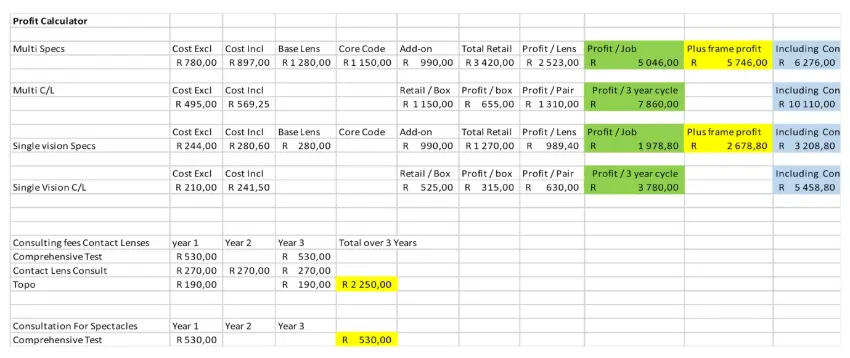
There is a common misconception that, in general, a patient who wears spectacles generates more profit than one who wears contact lenses. This conclusion is based on a flawed analysis, which considers only the profit from a single purchase, ignoring the long-term revenue generated by each patient type. Accurately calculating the gross profit of contact lenses versus spectacles would be difficult. The problem is that this would have to be a generalisation based on assumptions across a broad spectrum of practice modes, as well as the types of contact lens patients included in the sample. For example, some contact lens patients may have to be seen every 3 or 6 months. However, it would be safe to say that contact lens practice is not to be sneezed at and, in many instances, would deliver a higher gross profit than spectacles over a three-year period.
While it’s true that contact lens profit margins declined after disposable lenses became dominant, the financial contribution of contact lenses in standard practices increased due to two market factors: First, contact lens penetration grew due to the ease of intermittent wear for specific activities and interchanging with spectacle wear. Secondly, the annual amount spent per wearer increased. We can learn from the accurate sales data available in America. The growth rate of US sales of soft contact lenses has surpassed that of spectacle sales every year over the past 10 years. Over the decade, contact lens sales grew at a compound annual rate of 6.6 percent, as spectacle sales increased just 0.7 percent. Contact lens sales have proven recession-proof, while spectacle sales have not.
To do justice to the income potential of contact lenses versus spectacles, one should assess this over three years.
- Contact lens wearers have more frequent eye exams (every 18 months or less versus every 24 months for spectacle wearers)
- Make more frequent purchases (every year versus every 28 months)
- Also, buy and use spectacles and sunglasses.
Incremental business
Contact lens turnover as a percentage of overall turnover in South Africa averages between 3% and 5%. However, many high-performance practices achieve double that. The arrival of disposables in the nineties was a game-changer. For the first time, there was an avenue for repeat business available to optometrists without it passing through their own hands. Patients would come back to replenish their disposables without having to see the optometrist. To capitalise on this opportunity, it would be wise to wilfully build the base of disposable wearers by making the process as comfortable as possible. The bigger the patient base of disposable wearers, the more worthwhile this stream of incremental income would be. It will also open the door to bulk buying and keener prices.
Building the database
To capitalise on incremental business from over-the-counter disposables sales, one needs a clear strategy for building the database. The game plan should be to make it as easy as possible for your patients to enjoy the benefits of contact lens wear by being flexible with the mode of wear and pricing. For one, get rid of the old stigma that you have to choose between contact lenses and spectacles. Promote intermittent wear. Give some thought to the barriers to entry and how to eliminate them.
Prospective wearers would be reluctant to pay a contact lens assessment fee, only to find that it doesn’t work for them. Offer the trial on the basis that if it doesn’t work out, the patient doesn’t pay for the consultation. Another barrier to entry is handling the contact lenses. Consider the case of John, a fifty-year-old with – 2,50 ou. He is an avid golfer, and during the rainy season he has a torrid time with his specs on the course. John had tried contact lenses before, but bombed out on the handling and quickly became demotivated. The way to eliminate John’s barrier to entry is to demonstrate the benefit first so that he is motivated to persevere with the handling. Fit John on a Wednesday morning, instruct him to play his golf that afternoon, and have him sleep with the lenses that night. He must be back at your office first thing on Thursday morning to review the situation. You may well be dealing with a very motivated John who now understands the benefit he can enjoy by wearing contacts. Contact lenses offer such a win in many activities, such as contact sports. A twelve-year-old -4,00 D rugby player may only need three pairs to see him through the rugby season, but would be pretty useless without them.
Immeasurable goodwill can be created by making those with special needs an offer they can’t refuse.
Inventory
In today’s world of instant gratification, it is essential to carry all the inventory options. You never want a patient to walk out empty-handed when coming in to buy a fresh supply of disposables. It makes sense to choose a single brand rather than fitting patients haphazardly across multiple brands, which would require much more inventory.
Patient Communication
Regular communication with contact lens patients reinforces the long-term relationship you want to establish. You have their contact lens histories on record, and therefore, you are no stranger to them. Moreover, it is your professional duty to keep them informed of new products and developments in the field. Your software management system should allow you to set up a recall system designed for contact lens wearers. It should inform you when a patient is due for a follow-up visit, which may well be at a different interval suited to that patient. When a patient’s lens supply is depleted, your system should flag the patient so she can be reminded to pick up new lenses. Compliance is key to a successful contact lens practice. It is essential to be available to your patients when they need you. To this end, your front desk must be equipped to assess the gravity of the situation so that the appropriate calls can be routed to you.
Invest in knowledge
The scleral wave has hit with a vengeance. So many more destitute patients can now be fitted with remarkable results. This has opened up a brand-new market for optometrists. It is essential not to be left behind. We are fortunate in South Africa to have an active Contact Lens Society that hosts Contact Connect Conferences, where world-renowned experts will present. Moreover, it is an opportunity to rub shoulders with the most prominent contact lens practitioners in South Africa, who, I’m sure, will be happy to exchange ideas. I cannot think of a better investment than in one’s own skill set, and to this end, I believe one should save R2000 per month for CPD.
Fortunately, information is freely available with today’s technology at our disposal. Scleral Lens Practitioners is an excellent Facebook page with over 5000 members. Expert knowledge is shared there freely.
Product knowledge is vital. Practitioners need to know the designs and the theories behind them for everything available on the market. This holds especially true for multifocal lenses. The consensus is; a professional only deserves to be called an expert in a field if deemed so by his or her peers.
Spread your brand
Word of mouth remains the most fruitful source of new patients. Make sure that your practice is seen as “contact lens-friendly” through pamphlets and social media. The second most important source of patients is inter-professional referrals. If you have a particular interest in fitting scleral lenses, make sure the ophthalmologists and general practitioners in your area are familiar with the work that you do.
Conclusion
To get the most out of your contact lens practice, treat it as a business within your business. Contact lens patients require a different approach from your spectacle patients. Above all, it needs a particular strategy.