Interview with the Author
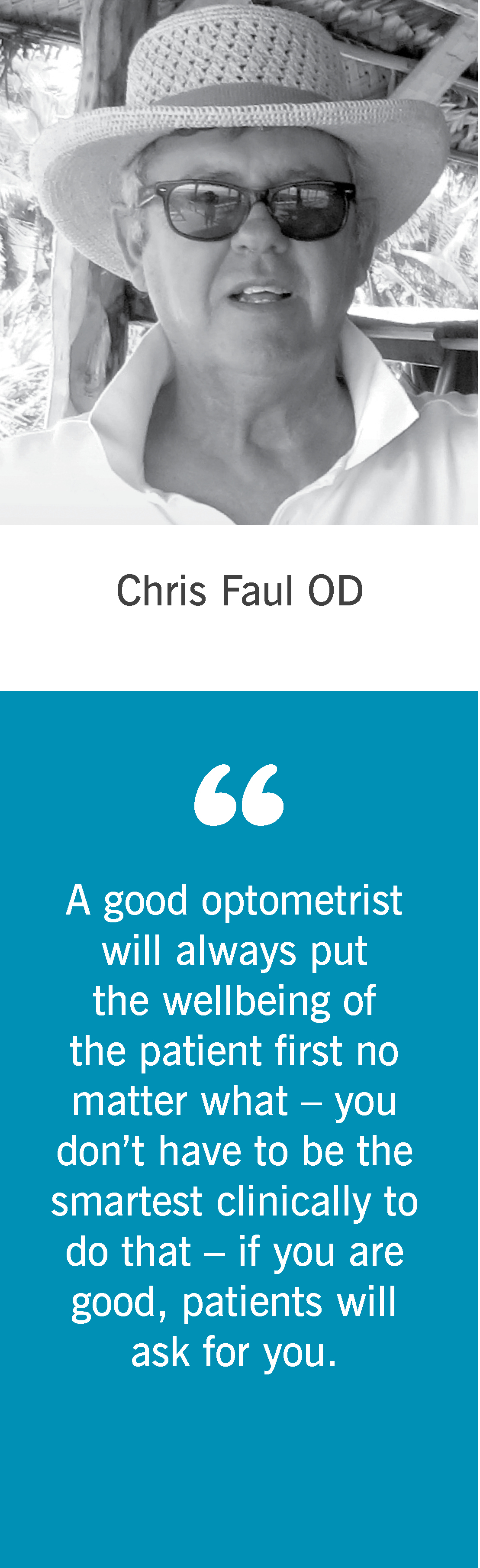
DR CHRIS FAUL
Founder of Spectacle Warehouse and author of Navigating the Business of Optometry
Why did you choose optometry as a profession and where do we find you today?
An optometrist, Joop van der Ham offered me a loan to study optometry. There werenʼt many qualifying in those days and it was difficult to find an optometrist prepared to go to a small country town – so I did. I live in Knysna. I tried to retire 12 years ago, but I am forever caught up in some project or other. I still consult.
Tell us more about your career path.
I practiced in King Williams Town for fourteen years – at the age of 35 I went to University of Houston College of Optometry to do an OD. I went diamond mining on the West Coast, lost a lot of money, and started Spectacle Warehouse in desperation in 1993. That is when I started learning about the business side of things.
Why did you start up Spectacle Warehouse?
There is a concept taught in 101 marketing called the Consumer Concept or Marketing Concept. It simply states that one should run a business from the customer's point of view. Optometry wasnʼt doing that – it was purely product-driven. In other words, it presented its offering in line with regulations and under the so-called professional code, but ignored the customer's needs in the process. For instance, the patient was never part of the process that determined the price – instead, they were just presented with an invoice at the end, finish and klaar. With Spectacle Warehouse we fixed all of that – that is why it did so well. We gave the customer reasons to love us and in those days it was something exceptional!
Was there criticism?
Yes of course! But today everybody is doing what we did way back then so I guess it is alright!
What has been the most exciting change within the profession in recent years?
The big one was the advent of disposable contact lenses more than twenty years ago. Ophthalmology has had the lionʼs share of amazing advances such as IOLʼs, OCTs, Lasik, and YAG laser. However, Scleral contact lenses have made a fantastic comeback and offer functional vision to many patients who would otherwise be destitute.
What do you consider the greatest threat to the profession?
The advance of artificial intelligence is becoming a major threat to many industries and it will no doubt impact optometry. Digital marketing, for instance, has changed the game and those who do not embrace it will be left behind. Only 14,6% of South Africans wear a visual correction and this is a problem, but nobody seems too concerned about it.
What should the role of the SAOA be?
It should promote the expansion of the scope of optometry.
What is required to be a ʻgoodʼ optometrist?
The first goal is to become clinically mature, which can only happen by seeing patients. So many young graduates choose the job that pays the highest instead of the job that offers the best experience. In my early years of practice, I saw, on average, 360 patients per month, and most optometrists did too, because demand far exceeded supply. Our profession has become a lot more competitive. An optometrist must understand the concept of emotional labour and its importance in the clinical setting. The only true measure of a good optometrist is how many referrals they generate. If people donʼt ask for you and travel to see you, you are, at best, mediocre.
What has been the biggest challenge in your career?
There was a time when I had to fight for financial survival – and survive I did. After that, it has been a great ride. One must not confuse conditions of business with problems in business. When your building burns down, you have a problem; when your best worker resigns, it is a condition one has to face repeatedly – conditions of this kind are part of the job.
Given the means to change the optometric profession in South Africa, what would you do?
I would strive to correct the gender imbalance (70% female) it is problematic and will become more so. We need a national board exam if we are serious about the standard of care. When I studied in Houston in the eighties, there was hardly any difference between a South African and an American optometrist, except Americans used diagnostics drugs. Today, you can't even begin to compare! Our standard of education falls short of international standards – even today, our students do not routinely dilate patients.
What is the best advice you have ever received?
If itʼs to be, itʼs up to me.
Who has had the most influence on you?
Beatrice Thatchu, a Xhosa woman, was my interpreter when I was a young optometrist. She taught me a lot about people and life. in general.
You authored: Navigating the Business of Optometry. What is it all about and who is it focused at?
Writing the book was much more complicated than I thought it would be. The book was aimed at optometry students and young graduates, but to my surprise, most buyers are established in practice. The book brings the business side of optometry to the practice owner in a format they can relate to. A lot of stuff in the book evolved from my experiences and worked well for me. I guess one would have to believe in it for it to work for you.
What are your plans and goals for the next five years?
Live life every day
One necessary extravagance and one pet peeve?
My music room and I donʼt suffer fools gladly
How do you spend your spare time?
I play bass in a couple of bands. I read a lot of non-fiction and love traveling. Boating is a passion; I love being on the water.
Your one desert island CD; ok whatʼs on your IPod?
It will have to be two – Brothers in Arms – Dire Straits and Gaucho by Steely Dan.
What are you reading at the moment?
The coddling of the American mind by Jonathan Haidt. I donʼt read fiction.
If you had to dispense advice to your fellow colleagues what would? it be
I wonʼt.